CIS and the VAT Reverse Charge for Solar Installers
Written and reviewed by the Solar Installer Accountants editorial team. Last reviewed 22 August 2026.
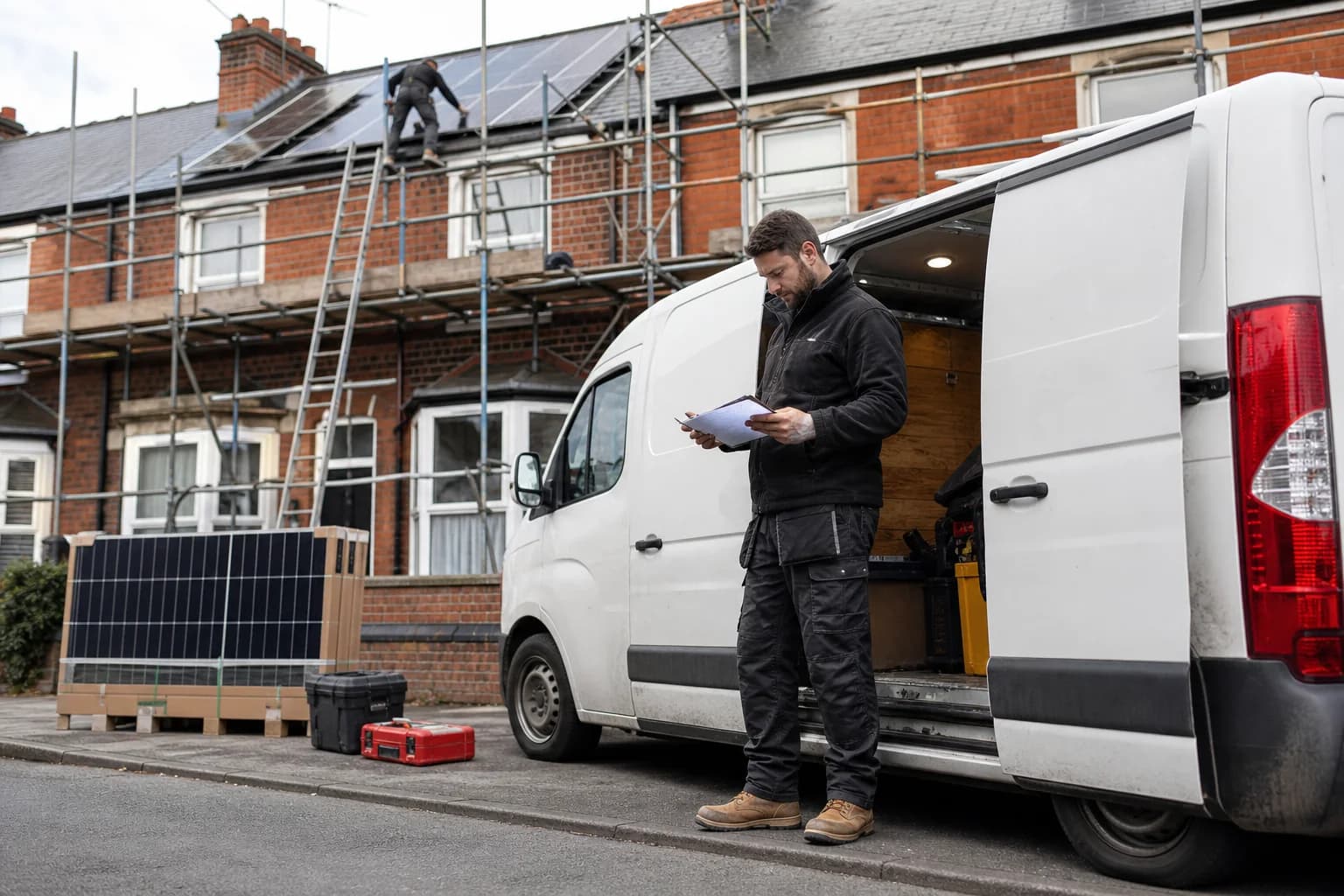
An installer working directly for homeowners never meets the Construction Industry Scheme. The moment a main contractor sits between you and the building, or you start paying other people to fit, both CIS and the VAT reverse charge come into view. The two are connected, and a lot of solar firms have been given the wrong answer on the second one.
This is when each applies to solar work, how the deduction is worked out on a job where most of the cost is hardware, and where the reverse charge stops.
When CIS Reaches Solar Work
CIS covers construction operations carried out for a contractor. Fitting an array to a building is construction work, so subcontracting to a builder, a developer, a main contractor or a retrofit coordinator brings you inside it. Working directly for a homeowner does not, because a private householder is not a contractor.
Registering is worth doing before you need it. A registered subcontractor has 20% deducted; an unregistered one has 30%. Gross payment status, where nothing is deducted, is available to firms that meet HMRC's turnover and compliance tests. The difference between 20% and 30% is pure cashflow, recovered eventually but not for months.
Once you pay someone else to fit, you are a contractor too, with verification to do, the right rate to apply and a monthly return with its own deadline. Growing solar firms are commonly both at once, which is where running a solar company's compliance starts needing real attention.
The Deduction Is Not Taken on the Panels
This is the single most valuable thing to get right on a solar invoice, because solar jobs are hardware-heavy in a way that most trades are not. The CIS deduction is calculated after taking off VAT, materials you paid for directly, consumable stores, fuel other than for travelling, plant hire, and manufacturing or prefabricating materials.
On a £12,000 installation where £8,000 is panels, inverter and battery, an invoice that itemises the materials separately puts the deduction on roughly £4,000 of labour rather than on the whole £12,000. At 20% that is a difference of £1,600 held back from you until your return is settled. On an invoice that does not split it out, the contractor may deduct on the lot.
The contractor can ask for evidence of what you paid for materials, and can estimate if you do not provide it. Neither of those works in your favour, so the split belongs on the invoice as a matter of routine, supported by the purchase records your bookkeeping already has to carry.
Why the Reverse Charge Usually Does Not Apply
The VAT domestic reverse charge shifts responsibility for accounting for VAT from the supplier to the customer on construction services reported under CIS. Where it applies, you invoice without VAT and note on the invoice that the reverse charge applies and how much VAT is due under it, and the contractor accounts for that VAT on their own return.
It reaches standard and reduced rate supplies. It does not reach zero-rated ones. HMRC's technical guidance is explicit on the point, and the consequence for solar is large: a zero-rated domestic installation is outside the reverse charge no matter how many contractors are in the chain. An installer told by a main contractor that the reverse charge applies to their domestic solar work is being told something that does not follow from the rate.
Two further carve-outs matter. The charge does not apply to an end user, or to an intermediary supplier, where they have told you in writing that is what they are. That notification has to exist and be kept, so it is worth asking for it rather than assuming.
What Changes on 1 April 2027
The reverse charge position is not permanent, because it is downstream of the rate. When domestic installs move from zero-rated to 5% on 1 April 2027, they become reduced rate supplies, and reduced rate supplies reported under CIS are within scope.
For an installer who works only for homeowners, nothing changes, because CIS was never in play. For one who subcontracts to main contractors on residential schemes, a whole category of invoicing changes at once. The reverse charge has caused sustained difficulty across construction since it was introduced, and professional bodies such as the ICAEW have tracked the practical problems throughout, which is a reason to prepare for it rather than meet it on the first return.